Your Burger Feels Expensive to Guests and Still Leaves You Too Little
Your guests think your burger costs too much, but you still keep too little after paying for ingredients. Raising the price again could protect what you earn on each order, or send customers elsewhere.
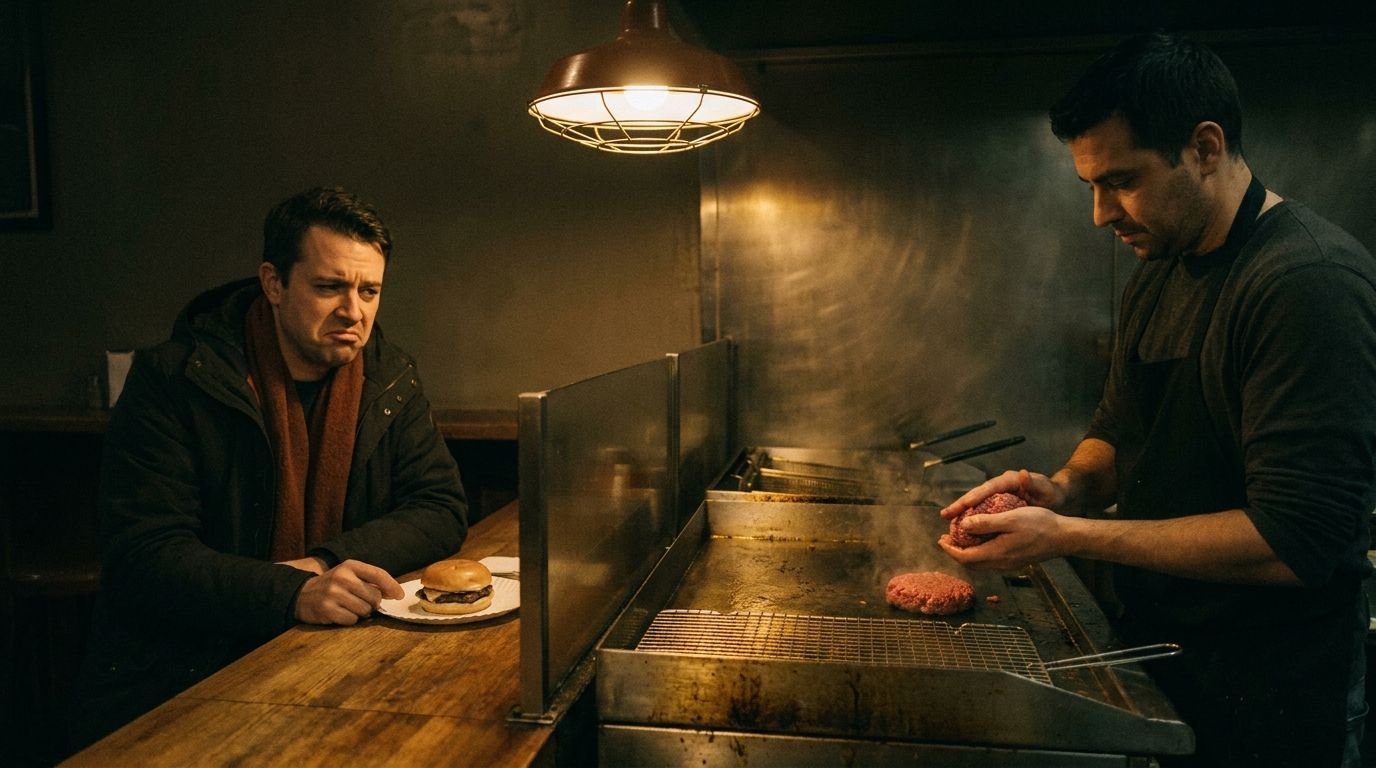
Your guests think your burger costs too much, but you still keep too little after paying for ingredients. Raising the price again could protect what you earn on each order, or send customers elsewhere.
In brief: Higher burger prices can coexist with thin margins when ingredient costs rise before menu prices catch up. Toast's available August 2026 excerpt does not include enough beef-cost or burger-price history to establish that this gap remains open across restaurants. For your restaurant, the useful test is to compare the timing of your own cost increases and menu changes, then check equivalent burger prices at nearby competitors.
A higher price does not mean you have caught up
Menu price lag is the delay between an increase in ingredient costs and a restaurant's corresponding menu price adjustment.
Your guest compares today's menu price with what they remember paying. You compare today's selling price with what it now costs to make the order. Both can reasonably conclude that the deal has gotten worse.
If your beef cost increased before you changed the menu, you absorbed the difference during that interval. A later price increase can improve what you earn on future orders. It does not recover the money already absorbed, and it may not fully offset the current increase.
That timing could explain your thin margins. The available national data does not prove it.
Toast's August Menu Price Monitor reports changes in restaurant menu prices. The available excerpt includes coffee prices, but not the beef-cost history and burger-price history needed to verify the timing gap. Those figures cannot establish that beef surged first and burger prices have yet to catch up.
Your own records can establish whether that happened at your restaurant. Put supplier invoice dates beside menu-change dates. Compare the ingredient cost and selling price of the same burger before and after each change.
Keep the recipe consistent. A different portion, a changed side, or an added ingredient can make a price increase look more effective than it was. After paying for the ingredients in that order, are you keeping more money, less money, or about the same?
Check the prices your guests actually see
Your costs tell you what a burger needs to earn. Nearby menu prices help you judge how another increase might look to customers.
Copying a competitor's price does not establish that you can afford it. Ignoring that price does not make it irrelevant to your guests.
Location matters even within the same chain. Drive Thru Index's Orlando comparison examined pickup prices at 333 restaurants. Its findings show why you cannot treat a chain's name as a single price point.
According to Drive Thru Index, a Whopper cost $6.08 at one Orlando Burger King and $8.92 at another. The same study found that prices for identical items within a chain differed by up to 47% across locations.
Those figures do not tell you what to charge for your burger. They show why you need the price at the actual restaurant down the road, not a broad assumption that a chain is cheap or expensive.
Each source answers a different question:
- Your own cost history: Shows whether your menu change caught up with ingredient costs. It cannot tell you what nearby customers consider a reasonable alternative.
- National menu-price reports: Show broader pricing direction. They cannot establish what guests encounter near each of your restaurants.
- Nearby competitor menus: Show current alternatives available to your guests. They do not reveal competitors' costs, profits, or whether their prices are working.
For your competitor price monitoring, record the ordering method, included sides, and any conditions attached to the advertised price. A pickup-only offer is not the same comparison as a burger served with fries in your dining room.
Test the gap before another increase
Before raising burger prices, check whether the evidence supports the same decision at every location.
Start this week with your best-selling burger, not a full menu review. For each restaurant, put the current ingredient cost, selling price, last price-change date, and comparable nearby prices together.
Use that comparison to weigh your options:
- Hold the price: Avoids another increase for guests, but leaves you absorbing any remaining cost gap.
- Raise the price across all locations: Keeps pricing consistent, but assumes local alternatives and customer responses are similar.
- Adjust selected locations: Accounts for different local prices, but requires careful menu updates and clear communication.
A nearby competitor charging more is not permission to raise your price. A competitor charging less is not proof that your price is wrong.
Separate a burger that feels expensive to guests from an overpriced burger, and both from a burger that still earns too little. Your cost records and local price checks help you decide which problem you need to address before changing the menu again.
Frequently asked questions
Why are my burger margins still thin after I raised prices?
Your increase may have offset only part of the rise in ingredient costs. If those costs increased before your menu price changed, you also absorbed the difference during the delay. Compare the same recipe's ingredient cost and selling price before and after the increase. That shows whether the money remaining per order improved. It does not, by itself, measure your restaurant's overall profit.
Does Toast's August data prove burger prices have not caught up with beef costs?
Not from the available excerpt of Toast's August Menu Price Monitor. It reports menu-price changes but does not provide the beef-cost and burger-price histories needed to establish that claim. Proving a lag requires both measures over comparable periods. Your supplier invoices and dated menu changes can establish whether a catch-up gap exists at your own restaurants.
Should I raise burger prices at every location at the same time?
Only if the evidence supports the same decision across your locations. A shared recipe does not guarantee the same nearby alternatives or customer response. This week, compare ingredient costs, current prices, and equivalent competitor burgers at each location before deciding where to hold or change your price. You will know where your own pricing gap remains, information your competitors do not yet have.