Your Sales Are Up. Your Business Might Not Be.
Your sales numbers look fine this month. Maybe better than fine.
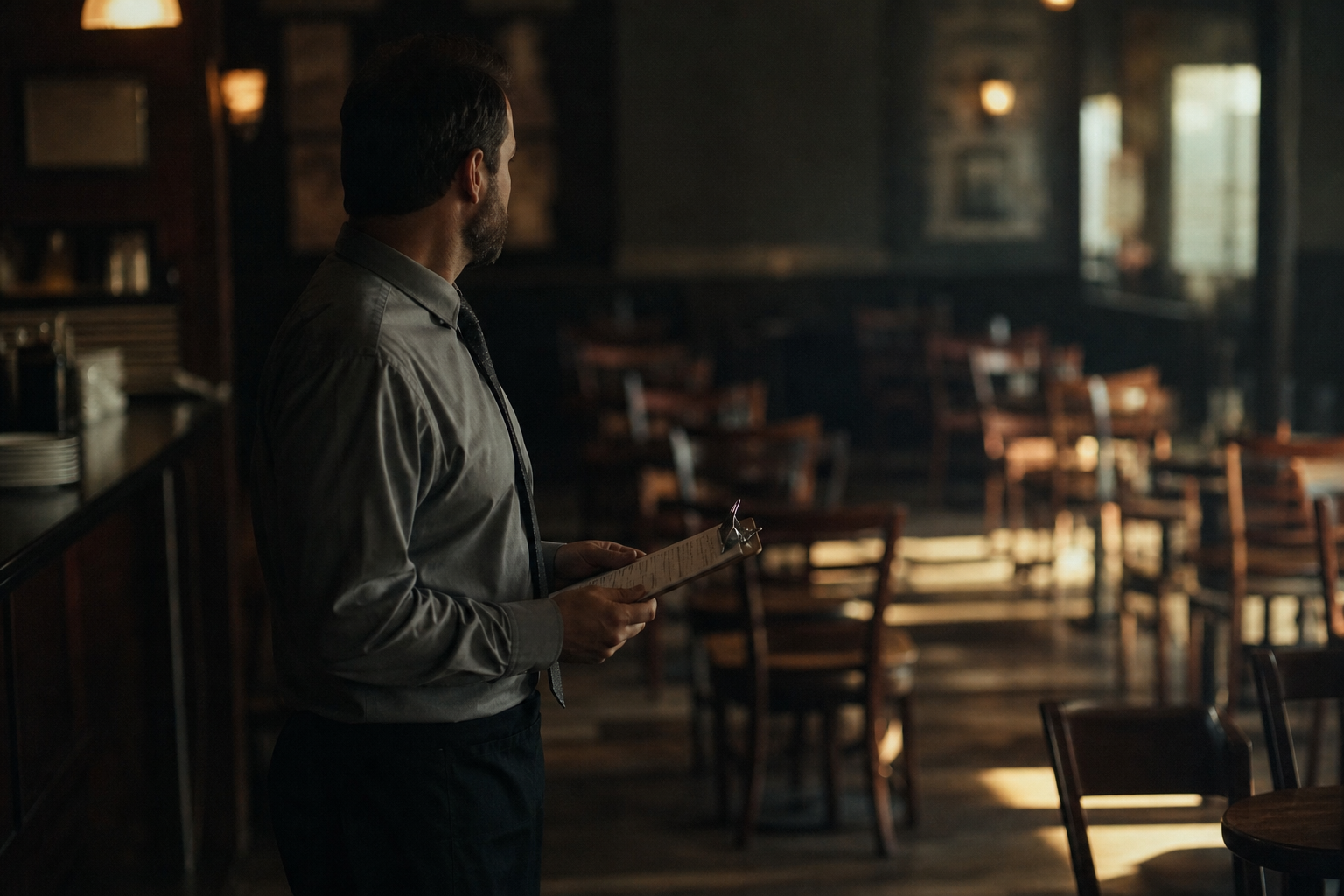
Your sales numbers look fine this month. Maybe better than fine. But something feels off, and you can't quite put your finger on it.
In brief: When same-store sales rise at the same time customer counts fall, the gap is almost always being filled by higher prices, not more business. According to the National Restaurant Association, 47% of operators reported higher same-store sales in July 2026 while 49% reported lower customer traffic in the same month. That is not growth. That is a pricing bridge, and pricing bridges have a weight limit. Operators who recognize this gap now can make decisions their competitors are still sleeping on.
The sales-traffic gap is the difference between what your revenue line shows and what your actual customer count is doing, and it is one of the most dangerous blind spots in a multi-location operation because the numbers that look healthy are the ones that get watched, while the numbers that signal real trouble get ignored.
---
The Math That Flatters You
Same-store sales is a clean, simple number. It goes up, you feel good. It goes down, you act. The problem is that same-store sales can go up for two very different reasons: more customers, or higher prices on the same customers, or fewer of them.
Right now, across the industry, it is almost entirely the second one. According to the National Restaurant Association, July 2026 marked the sixth consecutive month of net positive same-store sales reports, and yet customer traffic was negative in that same period. Nearly half of all operators are simultaneously reporting higher sales and lower traffic. That is not a coincidence. That is a pattern.
Menu prices were up 3.4% year over year as of June 2026, according to National Restaurant Association data drawn from the Bureau of Labor Statistics. Full-service restaurants were running slightly hotter at 3.7%. That increase is doing real work in your revenue line, masking the fact that fewer people are choosing to walk in.
If you run two to five locations, you might be looking at your weekly sales summary and feeling stable. But stable sales with declining traffic means each remaining customer is spending more, either because you raised prices or because the customers who were most price-sensitive already left and stopped coming back. Neither of those is a growth story.
---
Where the Bridge Breaks
Pricing has a ceiling, and a growing number of operators are finding it. According to QSR Magazine's reporting on Restaurant365's 2026 State of the Restaurant Industry Mid-Year Report, 48% of operators have stopped raising menu prices entirely.
That number matters. When nearly half the industry stops raising prices, the operators who keep raising them are not just absorbing costs, they are becoming the expensive option in a market where customers are already making different choices. According to Restaurant Finance Advisors, the industry has reached what analysts are calling a pricing limit, a point where further increases accelerate the traffic losses rather than offset them.
This is the moment the bridge breaks. You raise prices to protect margin. Traffic softens a little more. You raise prices again. Traffic softens further. Your sales line holds, or even ticks up slightly, so you do not feel the urgency. Then one quarter it does not hold, and you are looking at both lower traffic and lower sales at the same time, with a customer base that has already formed new habits somewhere else.
The operators in the most danger right now are the ones whose sales dashboard is giving them a passing grade while their dining rooms are quietly getting quieter.
---
What Your Competitors Are Doing With This Information
Most operators in your market are reading the same sales-up story you are. They are not watching their customer counts with the same attention. That means they are not adjusting, not repositioning, and not making moves while there is still room to make them.
Operators who are tracking traffic separately from sales right now have a real advantage. They can see which locations are holding customers versus which ones are just holding revenue. They can identify whether a specific location's traffic drop is a local issue, a pricing issue, or a broader market shift. And they can act before the sales line catches up to the problem.
Restaurant traffic remains soft across quick-service and full-service segments alike, according to Modern Restaurant Management's research roundup published September 2026. That softness is not evenly distributed. Some operators are holding traffic better than others, and the difference often comes down to whether they spotted the divergence early and made a deliberate choice about how to respond, whether that was a value-oriented promotion, a menu adjustment, or simply holding prices while competitors kept raising theirs.
Operators using tools like Ticket to track competitor pricing and local market signals are not waiting for their own sales to drop before they act. They are watching the market move and positioning ahead of it.
---
What to Do This Week
Pull your customer count data separately from your sales data for the last 90 days, by location. Not blended across your portfolio. Each one individually.
If sales are up and customer counts are flat or down at a location, you are running on a pricing bridge at that location. Ask yourself how much runway that bridge has. Look at what your nearby competitors are charging for comparable items. If you are already at or above their prices and your traffic is softer, you may have already hit the ceiling at that location.
If customer counts are holding or growing, you have a healthier business than your sales number alone would tell you, and you have more flexibility on pricing decisions going forward.
The point is not that higher prices are wrong. The point is that using revenue as a proxy for health is how operators get surprised. The gap between sales and traffic is information. Right now, you have it. Most of your competitors are not looking at it this carefully.
---
Frequently asked questions
What does it mean when same-store sales are up but customer traffic is down?
It means your revenue is being held up by higher prices, not more customers. Each customer is spending more, either because you raised prices or because price-sensitive customers have already stopped coming. The business looks stable on paper, but the underlying trend is fragile. If prices cannot go higher, or if remaining customers start pulling back, both traffic and sales can drop at the same time with little warning.
How do I know if my restaurant is covering a traffic decline with price increases?
Pull your customer count data and your sales data separately for the same period. If sales are up by roughly the same percentage as your recent price increases, and customer counts are flat or falling, that is the gap. It shows up clearly when you look at the two numbers side by side rather than relying on revenue alone as your health metric.
Is declining customer traffic a problem if my sales are still growing?
Yes, because it signals that your growth is not coming from more demand. It is coming from extracting more from existing demand. That works until it does not. Customers have a price tolerance, and once they form a habit of going elsewhere, winning them back costs far more than keeping them would have.
How many restaurant operators are seeing lower customer traffic right now?
According to the National Restaurant Association's July 2026 tracking survey, 49% of operators reported lower customer traffic compared to the same month the prior year, even as 47% reported higher same-store sales in the same period.
What should a multi-location operator do when sales look fine but traffic is soft?
Break your data down by location, not blended across the portfolio. Identify which locations are holding customers and which are holding only revenue. Check your prices against nearby competitors. If you are already at or above market and traffic is soft, further price increases will likely accelerate the problem. Consider whether a value signal, a menu adjustment, or simply holding prices while others raise theirs could help you hold the customers you still have.